Sourcing Is Partnership, Not Purchasing

September 2026
TLDR: Three years of intensive vendor searches have taught me that sourcing is really about partner selection. The buyer's leverage evaporates once tooling, lead times, and hard-won knowledge about your product are entrusted to another team. So, I cast a wide net, disclose my real parameters up front, weigh communication and values alongside cost, and I don't grind anyone on price.
The $250,000 win I'm not proud of
My first job out of college, in my early twenties, I managed a $35.8M global spend for powertrain components at a motorsport vehicle manufacturer.
One of those contracts was up for renewal. The incumbent was a US name-brand manufacturer you'd recognize if you work on your car. A vendor from India was coming in hard to win the business on price. Both sides claimed better quality, and I was measured on cost.
I played them against each other over several months and got a ~$250,000/year cost down out of the US incumbent to keep the business. After the renewal was signed, their rep took me aside and said:
"Hey Josh, your company's line about partnering with your vendors and prioritizing everyone's profitability is BS. I just had to sign this deal at a loss with you to keep a factory open and a dozen people in their jobs. You think you did something good today, but really you just hurt my team and our relationship."
I moved on from that job a couple of months later, with no real sense that that hard negotiation made any lasting impact for my employer. I extracted an ongoing quarter million dollars annually from a business that had been an exemplary vendor for many years, for a moment of recognition from my manager and the slightest boost to our numbers that quarter.
Today I don't remember his name, but that rep gave me the opportunity to reflect on how I want to treat other people and organizations. I've been learning from that conversation for a dozen years now, especially when I've sat on the other side of the table. It's about growing as a forest, not just my own tree.
The power dynamic is a mirage
It's easy to get distracted by the initial power dynamic of being the purchasing party. You have the money, so you have the leverage. That is a mirage.
It's actually a partnership. Once I've invested in tooling with a vendor, or am simply counting on the lead times, quantities, and pricing we started with, it's obvious that all parties must get their needs met, economic and otherwise, or things go sideways. My leverage at the quote stage is temporary, and being overly driven by first-line economics can cause me to miss ideal partners.
So much effort goes into these relationships from both ends, and some of the knowledge for how to make your product inevitably becomes embedded in their organization and their people. I will never know all the special jigs, fixtures, process tweaks, and experiments my vendors do for my projects, just like my customers will never know all the ones I do for them. That knowledge is real, expensive to rebuild, and doesn't transfer when you switch shops to save 8%. So, I keep the mental frame that every potential vendor could develop into a decade-long, or hopefully lifelong, partnership, even though at the start I'm the one deciding whether we move forward.
Over the last three years I've gone through the most intensive vendor (partnership!) searches of my career, across Medical Innovations International, Innovative Animal Products, Prototyping Tech, and Silent Surgical. Here's what has worked well for me.
I cast a wide net on day one
I used to take a week to research the one, or few, best vendors I could find, reach out, wait to hear back, schedule a call, then see if we were even a fit. By then a month had gone by. Now I reach out to every potential vendor I can find on day one via contact form, email, or phone, I ask for introductions, and I just tried a post on LinkedIn for recommendations. I like to speak with a hand full of vendors within 48 hours of the initial outreach, and not sweat when 1/3 to 1/2 of the people I message never respond.
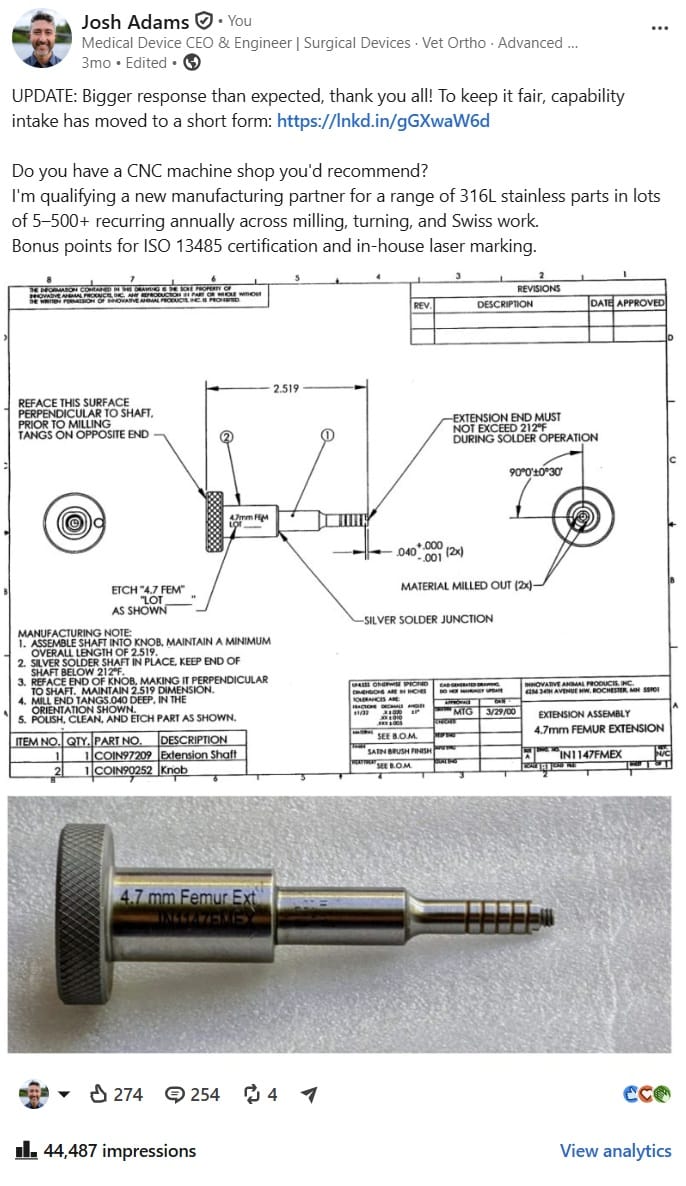
In a recent new vendor qualification round: In addition to contacting a couple dozen machine shops directly, I posted on LinkedIn with an image of one of our drawings and the corresponding part. I expected 5 or 10 comments. What I got was 40,000+ impressions, 250+ comments, and about 500 direct messages from vendors around the world. It let me collect ~150 full company profiles, quote 40, and select 3. The process took 3 months, and I can tell you with certainty the effort will serve my business for decades. I found exceptionally matched medical machine shops aligned on capacity and cost, I have about a dozen backups in case anything falls through, and half a dozen of the vendors turned out to have either sterilization or molding processes in-house that I've since explored working with them.
Give yourself lots of shots on goal, in parallel. You get the mental freedom of not forcing a fit, and you learn how to describe your need and pitch your business through repetition.
I learn (a lot) along the way
Every new sourcing project is an opportunity to learn. Often learning is a necessity, and the very people I'm speaking with are the ones teaching me about their industry and what I actually need from them.
It can feel like a controlled fall when I'm sourcing in a new space. I may be learning the nuance of a manufacturing process, a new quality standard, cost expectations, and the abundant acronyms and unique vocabulary of an industry, all while trying to run a credible search. The fastest way to learn, for me, is to talk to people who do it for a living.
If you share up front where you're at, they won't hold it against you. You're giving them an opportunity to win your business, and as long as you're honest, it's a clean exchange. Salespeople love a fresh lead that falls into their lap. Salespeople hate having their time wasted with no chance of a financial outcome. You can say something like:
"I'm new to your field, so I've sent out a number of messages to folks like you in hopes of finding a great match. Here's what I need: ____. Are you the right person to talk to? If so, could you share how you work and what you'd need from me? Please don't be shy to tell me we're not a match, and if not, got any recommendations for other folks I should reach out to?"
I disclose the dealbreakers up front
Once I know what I need in a partner, I lead with it: certifications, experience, processes, precision, lead times. Let them know before they invest 8 hours preparing a quote. Just as important, anticipate what might make you a bad fit for them and share that too: your volume, spend or shipping frequency, high mix of parts, or your lack of experience in their industry. I try to lead with a quick snapshot of my business and need, plus any potential dealbreaker for either of us. Better to disengage before you’ve both spent hours and weeks in communication.
AI has been useful for searching, but not discerning
Tools like Gemini's deep research have been useful for finding and compiling vendors I couldn't find through online searches. But when I've asked AI to analyze my spreadsheets and advise me on the best match, it has done a truly bad job. At least in the middle of 2026, I don't lean on AI to tell me which vendor is a good fit. Sadly the effortful use of my own human brain is still mandatory.
Those are my search and early filtration methods. The rest is about what I weigh once the quotes are in.
It's not all about price
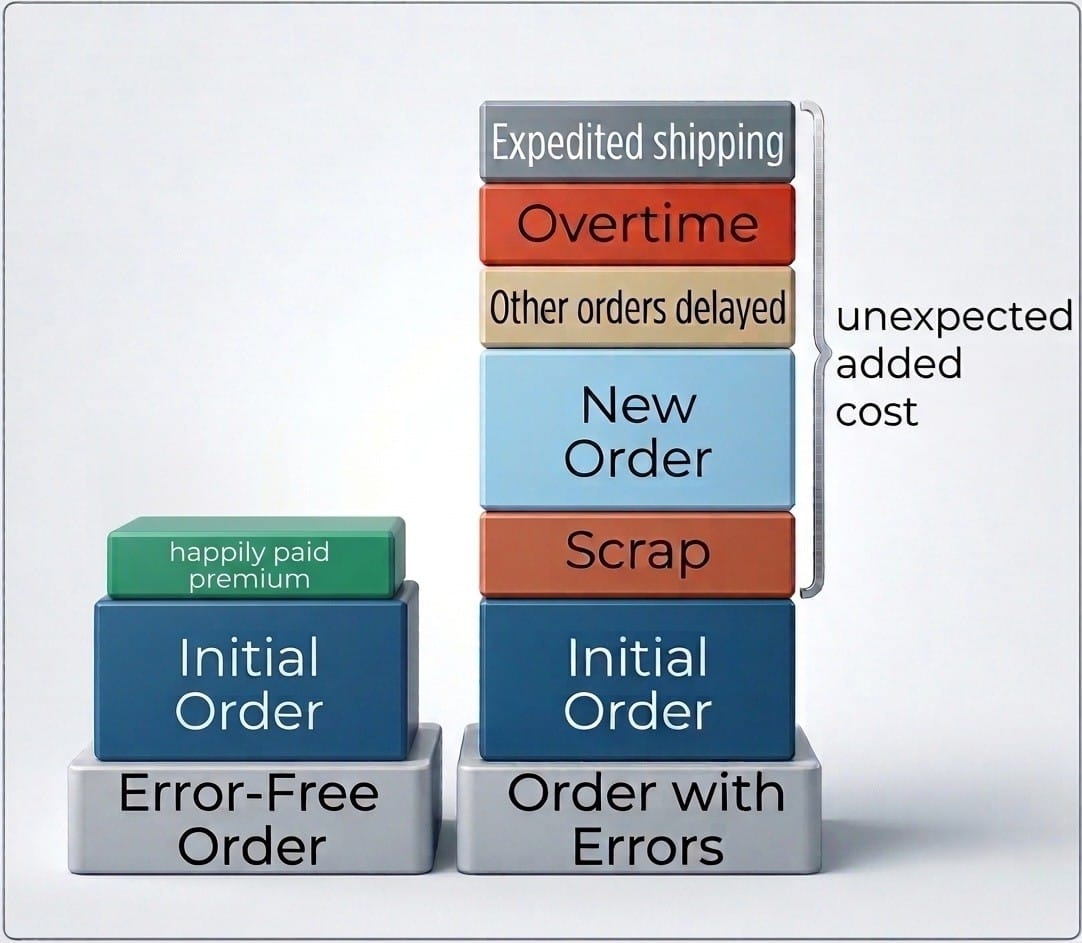
I don't beat people up on price. I trust vendors to give me their real numbers, and honestly, I lose some trust when I tell a vendor we're not a match and the first thing they reach for is a cost reduction.
I've also been on the receiving end of a price that was low because someone made a mistake. Unsustainable pricing, whatever the reason, will cause a correction later and works against a stable system. A price that's low because this is their specialty and they have the volume/efficiency to offer a lower cost is the holy grail. However, it can be tricky to tell competence from a mistake or a lure.
I try to visit every vendor in person
When that's not possible, I ask for a virtual walkthrough. I'm watching for organization and cleanliness appropriate for the work; there's a very different standard for medical silicone molding than for a spring bending shop. I'm trying to discern if the physical space reflects functioning internal systems.
Another signal is the staff: Are they appropriately dressed and following safety protocols? Do people appear to take their work seriously? When you walk through a shop where the staff is focused and the space is organized, you can feel it.
I pay attention to what vendors say publicly
Some of what vendors have posted on LinkedIn has changed my desire to work with them. I struggled with this, because I don't want to limit my partners by something irrelevant to our work like surface level politics, nationality or religion. What I have realized however, is that integrity is a fundamental quality I seek in people and organizations I work with. Sincere and impeccable expression of a belief in an appropriate context, earns my respect even if we voted for different people.
How a companies leadership voluntarily shares publicly gives you a hint as to how they may behave when something goes wrong on your job. And something will go wrong if you work together long enough. How will they treat you when you make a mistake, or they do, or something hard happens that's no one's fault?
Relationships compound
I'll leave you with this: building a network of partners is part of the compounding growth of a career.
Money compounds with interest. Your ability to create products and bring them to market compounds with the relational resources you start and build over years. When you foster great relationships with people and organizations, they become an extension of your team and the capacity. And those relationships get to come with you between jobs and across the greater arc of a career.
Wishing you all a creative month,
Josh