Modernizing a Veterinary Product Line (Without Breaking It)
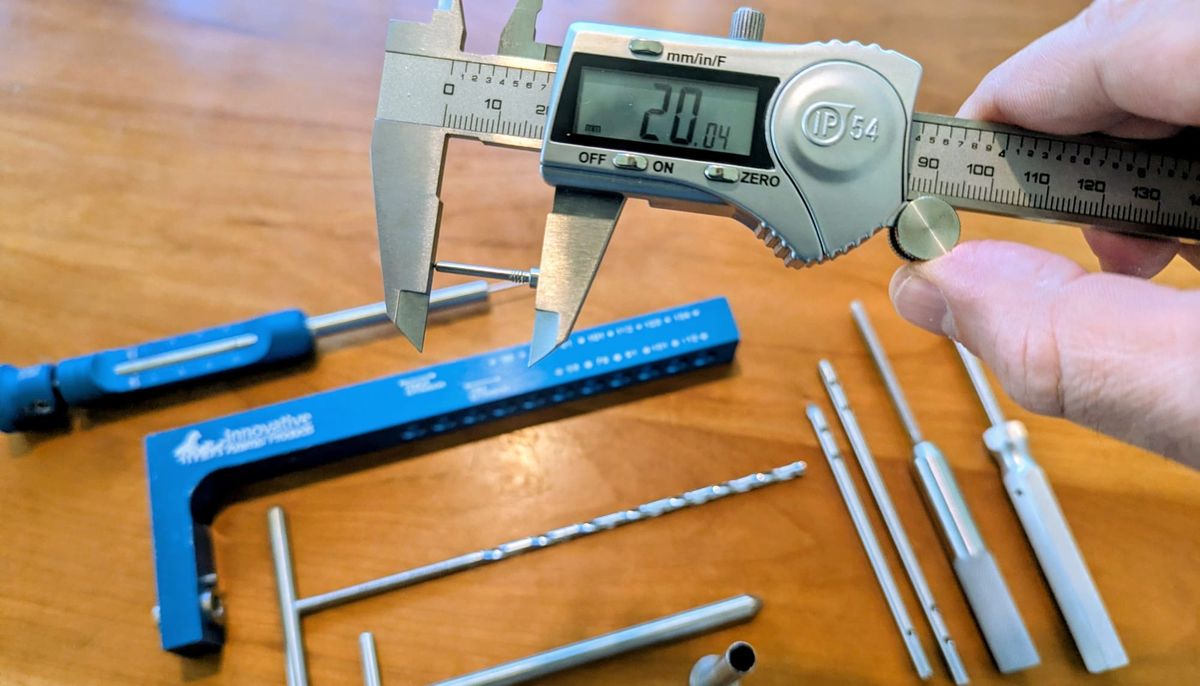
July 2026
TL;DR — Updating a 30-year-old veterinary orthopedic surgical device:
The Interlocking Nail System has been the heart of the Innovative Animal Products business since the 1990s. For nearly 15 years it’s been treated like an end of life product line without meaningful updates.
The update has progressed through four phases:
- Excitement (cool system!)
- Digging in (into overwhelm...)
- Doubt (will this work?)
- Crystallization (better than expected!)
Metaphor. The blind men and the elephant: every veterinarian, machinist, and staff member held a piece of truth, but nobody held the whole picture.
It came together. We’re cutting the part count of instruments by about half without losing functionality, and have started a fully backwards compatible redesign of the system with a new solution to an old performance problem.
Brand update and relaunch are coming in early 2027.
Full story below. ⬇️
When you decide to update a legacy product line, it can seem simple. You can see some issues at first glance and may have early ideas on how it might be better. For me, the full story only tends to come out after weeks/months of investigation, serendipity, and study. This post is about my work on the Innovative Animal Products (IAP) Interlocking Nail System over the last 12 months, a roughly 30 year old system that has actively (and passively) evolved over the last three decades.
Phase 1: Excitement (Naive?)
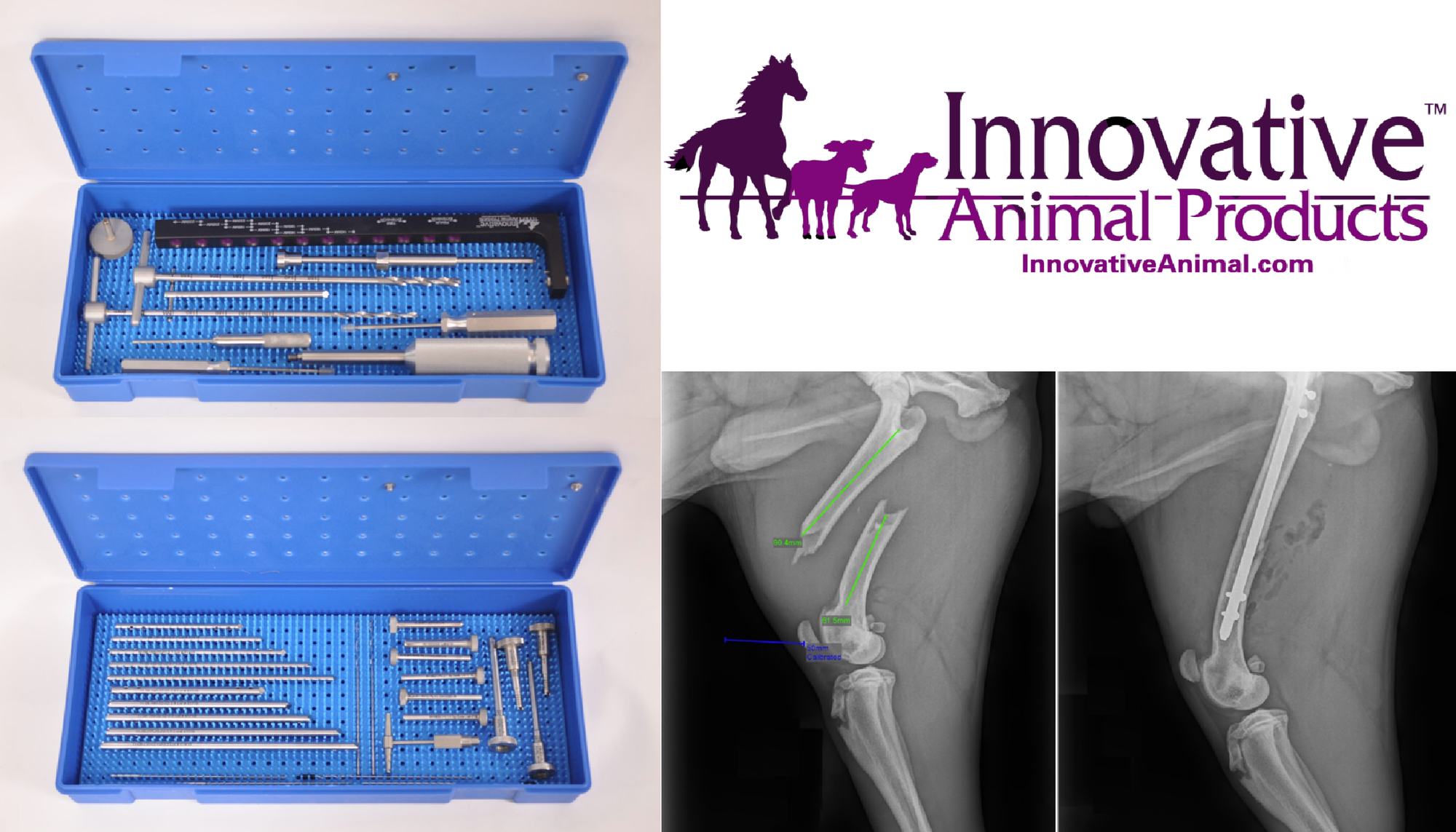
The Interlocking Nail System was developed in the 1990s with Dr. Tass Dueland and the Gauthiers. It became the heart of Innovative Animal Products, as the first translation of interlocking nails from human use to veterinary orthopedic surgery (think of a rod offering fixation to a serious fracture by passing through the central canal of a long bone). It’s an invention and system that has passed through thousands of hands for over three decades: owners, machinists, engineers, our staff and veterinarians on at least 4 continents.
When an earlier owner who drove sales stepped away around 2012, the outbound demonstrations, sales efforts, updates and a number of controls stopped or slowly fell off. When I arrived, I saw a great device that used to be the incumbent system for orthopedic veterinary long bone fracture surgery, but for nearly 15 years it's been treated as an end of life product line and was in need of attention and an update.
The system still had a loyal customer base who loved the simplicity, and cost effectiveness of the Innovative Nail (as it’s known in the community). However, most veterinarians simply didn’t know we were still in business, since we’d vanished from conferences or any meaningful community participation for the last ~15 years.
As I invested most of my time in the other areas of the business (in the human medical devices under the Medical Innovations International brand, and our general operations), I had the opportunity to speak to and meet veterinarians, and tour the surgical suite of one of our customers.
Phase 2: Digging In (beware of Overwhelm)
There is an old parable about four blind men discovering an elephant by touching discrete parts of it. One feels the trunk, one the leg, one the tail, one the side. Each becomes certain he knows what an elephant is, thinking a whole elephant is represented by the small part of the creature that was touched. None is wrong about their piece. All are wrong about the whole.
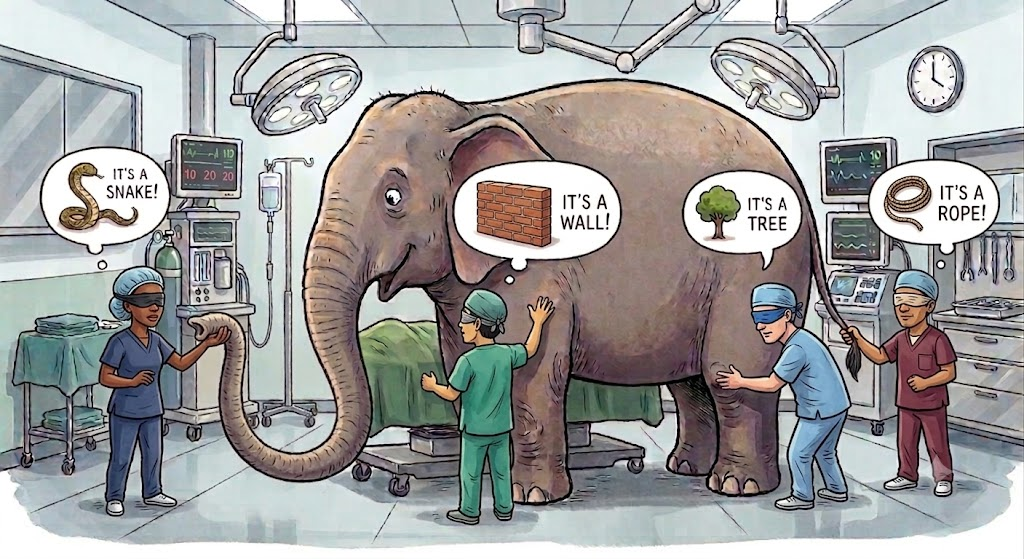
Every person connected to the Interlocking Nail held a viewpoint on the truth, but no one held the whole–designs, manufacturing process, training process, use in surgery, sales and demand, competition, needed updates, niche use cases, community perception, and clinical outcomes. The veterinarians who use it know what works for them in surgery, and where there can be challenges. The previous owner held the commercial intent and bottom line economics. The internal machinist and CNC vendors held how the parts were made. Our office manager understood the day to day reality for vets needing new implants and ideas that they mentioned more causally over the phone.
The work of this phase was collecting as much perspective as possible. It takes time to meet stakeholders in a demographically diverse community, to visit a surgical suite, to go through all the surgical videos, training materials and product catalogs, and to hear about production needs or special requests. Each one revealed another part of the elephant I had not known was there, or just had a hint of previously. Every conversation showed the system was more nuanced and less documented than the last one suggested.
Examples:
- None of the components had 3d models and several had no documentation whatsoever, other than what was in our machinists head.
- Some surgeons requested a unique tip to the nails for ease of use in certain types of surgical application where the nail follows the reamer through the intramedullary canal.
- Another veterinarian casually mentioned that they interchangeably use components that were initially designed for exclusively tibia or femur applications with success.
- The previous sales lead and product owner generously met with me and let me know how a competitor came on the scene and exploited a weakness by misrepresenting the stability of our implants (as far worse than they were in practice), and what research showed was a real opportunity to improve healing outcomes (through increased stability between the nail that passes through the center of the bone and bolts that fixate it to cortical bone).
It can feel stressful to be the person in charge of updating a high consequence product line (especially something used in medical care and surgery), and discover decades of depth, nuance, preference, research, and use. When a real animal is on a real table and a veterinarian is depending on the system to perform as designed, the question "will this work?" carries weight. The cost of getting it wrong is not a returned product, it is a failed surgery.
Phase 3: Will this actually Work?
For about nine months, this stayed a background process, speaking with veterinarians that appreciate the product and learning about challenges as they surfaced, while my focus was primarily elsewhere. Then came a couple of veterinarians who loved the Innovative Nail and had been developing a new bolt for it that solved the stability issue. It was time to elevate the Innovative Nail to the top of the stack!
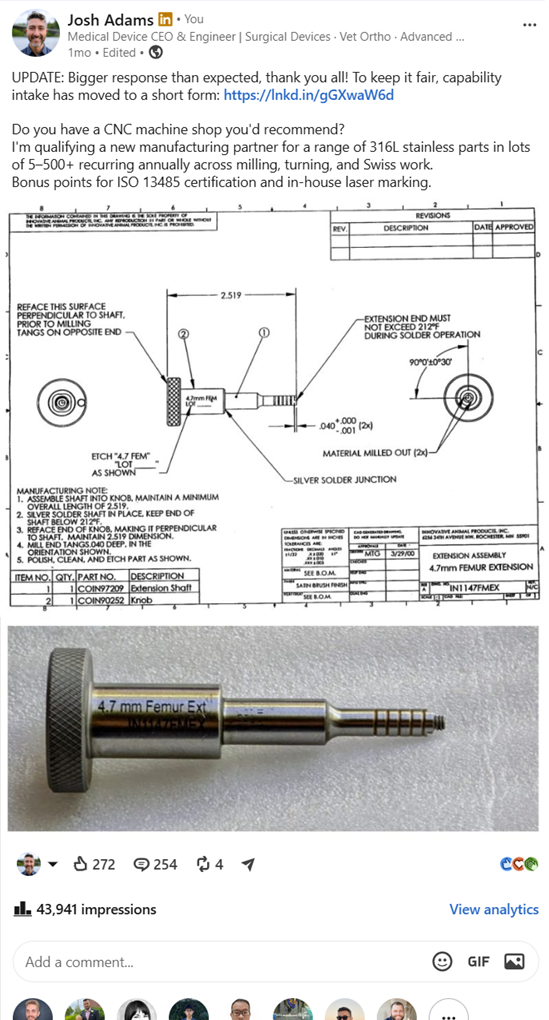
Discussions with them on how to license their invention led to the need to truly understand and update the whole system from instrument design to manufacturing method. This also led to a post on LinkedIn calling for recommendations for some CNC vendors–I expected 5 or 10 responses, but ended up getting about 500 messages from shops around the world.
This all led to a deep dive into studying the system and learning that a number of instruments were redundant, discovering the root cause of certain quality and other issues, and how the system needed to be packaged to better suit veterinarian needs.
It all kept building and building, like there were 5 then 10, then 50 balls in the air–each representing a significant decision that worked in concert with and made a material impact on each of the other factors. This is where pressure can build, and you just have to keep going until things start making sense.
Finally last week in Rochester, MN the final set of pieces metabolized into understanding to serve as a foundation that everything else could orchestrate around.
Phase 4: Crystallization
After far more research, conversations, prototypes, and attempts than the excitement phase ever pictured, the system started to come together in my mind. The elephant of the system has assembled into a whole--there may be an extra tusk, ear or hairy patch I have yet to discover, however, what I know now gives me enough context to make confident decisions that I know will both improve and not break the system.
I now know we can cut about half of the currently offered instruments and have a full system that works better than ever, and is backward compatible with the 3 decades of product in the field. I know how the remaining product can be adjusted in about 50 different small ways to address manufacturing complexity, reduce quality risks, and make the set perform better. And we’ll be bringing on a new type of veterinarian designed bolt that solves the issue that caused us to slowly lose market share for the last 15 years.
None of it came from a flash of insight. It came from all those mini insights forming into one picture.
What's Next: Redesign and Relaunch
The next step is translating insight into the physical redesign and testing of the products and the brand so they represent who we are today while honoring the legacy of a great invention.
Grateful that this will be a restoration and update, not a teardown. We’ll be able to keep what made veterinarians love the system, save cost and complexity for our customers, serve the animals walking with our implants with measurably reduced recovery times, and move forward with manufacturing partners utilizing technology available today.
The relaunch is coming soon, most likely in Q1 of 2027.
Lesson
Updating an existing product line is never the few-weeks job that the excitement phase imagines. It is a full arc that takes the time it takes. Doubt and overwhelm is par for the course when you are digging deeper than you knew it went–good on you for following the rabbit hole as deep as it goes.
The people who come out the other side are the ones who keep having conversations until the elephant comes into full view without getting stuck needing to know about every irrelevant wrinkle. Part of the work is keeping going with the necessary patience as you learn into places you didn’t know you’d have to go.
An Invitation
If you happen to have experience with the Interlocking Nail System, reach out and let me know. I am asking partly to build relationships in the veterinary community I have come to respect, and partly because your piece of the elephant might be one I am still missing before we relaunch.